What Is the Difference Between Abstract and Nonrepresentational Art?
There are three basic types of Visual Fine art. Subcategories exist in each of these types. Oftentimes, these types are misrepresented or more than oftentimes, misunderstood. Whether the work is three dimensional sculpture or two dimensional, it will still autumn under one of these 3 principal types. These types are representational, abstract, or non-objective. The intent of the artist frequently times informs u.s. on the type of art at which nosotros are viewing. Across this, the awarding of the medium tin can also accept an effect on the type of artwork.
Representational Art
Representational artwork aims to represent actual objects or subjects from reality. Subcategories under representational art include Realism, Impressionism, Idealism, and Stylization. All of these forms of representationalism represent actual subjects from reality. Although some of these forms are taking steps toward brainchild, they still fall nether the category of representation. Representational art is perhaps the oldest of the three types of fine art. It can be traced back to the Paleolithic figurine, The Venus of Willendorf. Information technology is likewise the easiest to digest from a viewer's perspective.
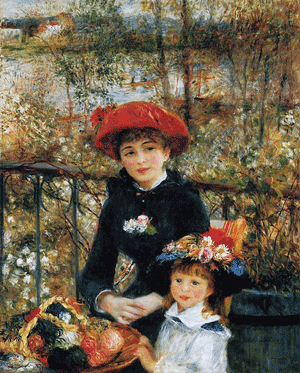
Pierre-Auguste Renoir. Ii Sisters (on the Terrace), 1881
We tin can easily identify with recognizable subjects in a painting, drawing, or sculpture. This makes representational art widely accepted among the masses. Representational art also represents the largest collection of artwork created. Considering that the other ii types, abstract and non-objective, are relatively new types of fine art, this makes perfect sense. Representational art has gone through many phases and movements, however the principle of presenting the viewer with recognizable subject matter has stayed the aforementioned. It is worth noting that some representational art flirts with abstraction. It could exist said that some representational artwork happens to be more realistic while other forms focus on the artist'due south perception of the subject.
Abstruse Fine art
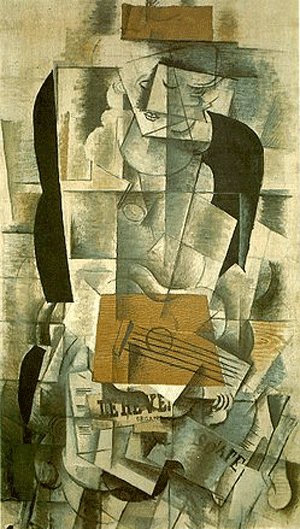
Georges Braque. Adult female with Guitar, 1913
The often misunderstood blazon of art known every bit abstraction aims to take subjects from reality but present them in way that is different from the way they are viewed in our reality. This may take the course of emphasizing lines, shapes, or colors that transform the subject field. Abstract art includes the subcategories of Minimalism, Cubism, and Precisionism. Brainchild can as well happen when the artist decides to view the subjects in a non- traditional manner. Abstraction is relatively new to the fine art world, having information technology'south primeval roots in the deviations from reality taken by the Impressionists. Information technology began to gain popularity in diverse forms effectually the world at the end of the 19th century. Artists began to have a more intellectual approach to painting.
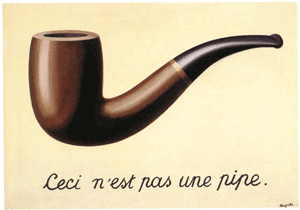
Renee Magritte. The Treachery of Images, 1928-1929
This new fashion of approaching art is evidenced in the Magritte painting entitled, "The Treachery of Images", 1928-1929. Written in French under a representational painting of a pipe, is the phrase, "This is not a pipage." The point is that the painting is indeed not a pipe, only rather a painting of a pipe. Artists of this time where now approaching paintings every bit paintings, allowing for a new form of intellectual expression. Many people take difficultly in understanding the differences between abstract fine art and non-objective art. The clear divergence lies in the subject field affair called. If the creative person begins with a subject from reality, the artwork is considered to exist abstract. If the creative person is creating with no reference to reality, then the piece of work is considered to be non-objective.
Non-Objective Art
The tertiary type of art is often mistaken for Abstract art although it is entirely different from it. Non-Objective art takes nothing from reality. It is created purely for aesthetic reasons. The intent of Non-objective fine art is to use the elements and principles of fine art in a way that results in a visually stimulating work. It is purely that simple.
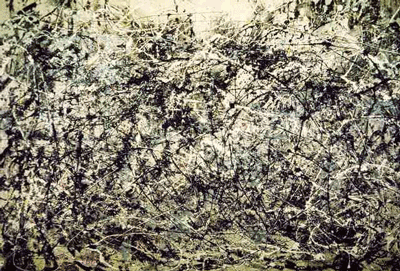
Jackson Pollock. Number I 1948
Source: https://thevirtualinstructor.com/types-of-art.html
0 Response to "What Is the Difference Between Abstract and Nonrepresentational Art?"
Post a Comment