A Level Textiles: Beautiful Sketchbook Pages
Last Updated on January 5, 2022
Halima Akhtar is an exceptional student who gained an A* for both Edexcel A Level Art (100% at AS and A2) and A Level Textiles (100% for AS and A2 Coursework projects and 98% for both examinations). This article features her Equally and A2 Textiles projects, completed while studying at Woldingham School, Caterham, Surrey, United kingdom of great britain and northern ireland. Halima gained an A Level Fine art Scholarship and went on to gain a Distinction for her Art Foundation year. Halima's sketchbooks contain rich, mixed media pieces, sculptural exploration, fabric investigations, manipulation of materials and experiments with stitching, surface and blueprint. A journeying that begins with first-hand ascertainment and ends with circuitous, three-dimensional pieces, Halima'southward Every bit and A2 Textiles projects are superb exemplars for others: some of the best A Level Textile sketchbooks that I take seen.
Ii of Halima's sketchbook pages are included in our new book: Outstanding High Schoolhouse Sketchbooks . This book has loftier-resolution images and then that fine details and annotation are articulate, making information technology an excellent resource for students and schools. Larn more!

We were lucky enough to interview Halima about her projects. Her responses almost start-hand observation and how she approached her themes are peculiarly valuable.

Information technology is important for high school Art projects to work from first-hand observation and respond to the world effectually them. It is sometimes unclear how this applies to a Textiles project. Please explain how you were influenced and inspired by kickoff-hand ascertainment.
Halima: Coming from an Fine art background at GCSE when I approached my kickoff As Textiles projection 'Growth and Decay' I felt information technology was important to utilize the skills I had learnt, which included cartoon and painting from first-hand resource to record visual information. This way of working has fed itself through my textiles and art to this day. Through my A Level Textiles course I was able to embrace the notion that textiles has much more to offer than making clothes; it is well-nigh working with materials and surfaces sculpturally to notice endless possibilities to explore.
As artists nosotros should embrace the sensuous feel, peculiarly inside the context of research in textiles. Information technology is not only about how things look only as well the style the feel, smell, sit or can exist handled. Each of these qualities can provide such rich information most texture, shape, form, color and structure to inspire piece of work.
With the championship 'Growth and Decay', the primary thing that struck me was the concept that fungi grows as a process of decay and degeneration. I went looking around forests and outdoor areas to find examples of fungi in the natural setting. The tremendous calibration, smell and slime that I often saw growing around these forms – observations I could not have made through photographs – inspired my work greatly as I experimented with textile qualities. Within my 'Armour' project (encounter farther below), I as well drew a connectedness with natural forms and insects, where some of the repetitive and layered protective shapes were similar in these two entirely separate structures.
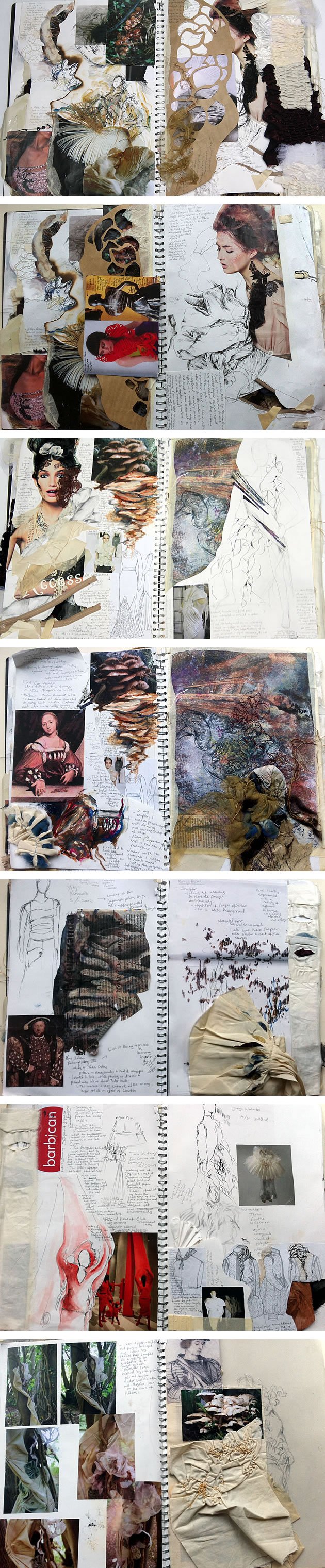

I feel one of the master reasons that I was able to explore then much in my A Level Art and Textile projects was that not simply did I actively take a part in searching for this start-hand experience, but I enjoyed it every bit function of the natural procedure of making. The records that I made in drawings and notes also became of import references for later.

The idea of working from first-hand resources doesn't demand to exist limited to subjects to draw from. Inside my work, observing and taking note of processes and the way in which things happen every twenty-four hours helped to widen my perspective. I believe there is a beauty in taking something ordinary and often unnoticed and being able to comment on it, transforming information technology to make it important and notable.


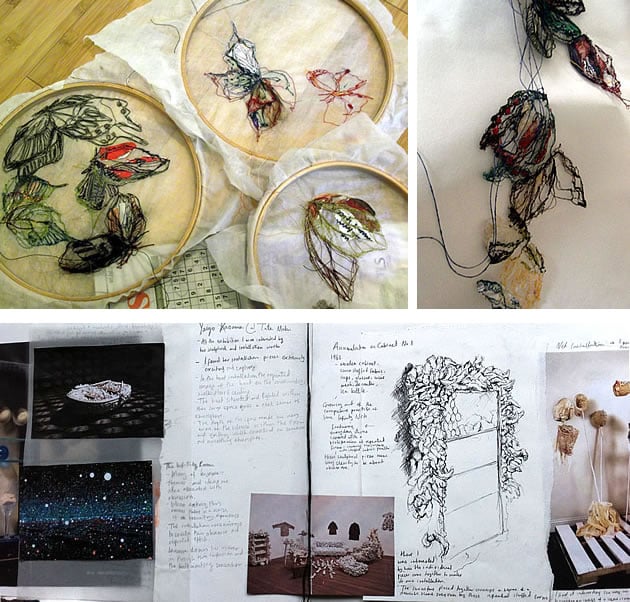
Equally I moved on to the second year of the A Level Textiles form, my observations of first-hand resources underpinned my practical work and the exhaustive reflection necessary within my Coursework contextual essay. I was primarily interested in the sequential process of metamorphosis in butterflies and in order to understand this I purchased a small-scale butterfly hatching kit. The insects came in a pot and I observed closely their cocooning, hatching and release. The inspiration I gained from this experience was invaluable. It was breathtaking to see such intricacy and awe in something that happens every single twenty-four hours. The cocooning concept provided the basis for my project, every bit I was fascinated by this idea of a container with connotations of entrapment and protection. I reflected on how I, also, containing these animals in an artificial setting, had meddled with the boundary between appreciation and being harmful. This brought about the idea of 'collecting' inside my enquiry and pushed me to develop more conceptual and meaningful ideas in my work. The commonalities and contradictions in placing these two bug alongside each other was interesting and I was able to utilise the imagery of the metamorphosis and insect infestation to convey the concepts of compulsive hoarding in a creative manner, initially unexpected to even myself.

Your piece of work uses a cute array of mixed media. Please talk to u.s. about the materials and mediums you used and why you selected these.
Halima: The observations I fabricated in my drawings led organically to textile samples, For example, using wadding to make trappings conveys the quality of translucency and the idea of entrapment that I observed in the compacted wings of the butterfly folded within the cocoon.
On reflection, much of my work and drawings strive from a place within me where I am trying to understand or depict, through marks, a certain texture or form. This is obvious in my AS Textiles Coursework project, 'Growth and Disuse', where my sketchbook is filled with material tests and drawings in different media, such as paint, ink, pastel, stitching, string and fineliner. When working from the inspiration of fungi, the qualities within the course influenced the mediums and marks I chose. In my experiments – then my terminal piece – I used different colours of felt melted together within a sandwich of cling film and so costless machine stitched over to create a unproblematic line drawing. I wanted to evoke a tactile moss-similar quality that was alluring, despite existence inspired past the slimy, almost repulsive texture of the fungi.
For me, there is something compelling about taking textile methods and processes and subverting their functional purpose or worth in more fine art pieces, such equally installations or 3D mixed media drawings. Within a fine art setting there can be an unspoken rule of distance betwixt a viewer and the work: with my textile pieces I am really trying to challenge and evoke this desire to connect through affect.

My material sampling developed from bones introductions to processes to those that I discovered on my ain. Experimenting with processes and combining different materials through simple deportment often provided me with more insightful concepts to push further. I am fascinated by the idea that in each cut, stitch, tear or marker the viewer sees the maker manifested physically. It is incredible how the mind leads the hands and body to create something entirely new. Looking at the work of others with this perspective, an understanding of textiles is universal, every bit we all are capable of using our hands and challenging the ways we practice this. This is why I am fatigued to mixed media, as it requires then much workmanship and this attention is visible at the immediate surface.
In my piece of work I always try to convey something fluid; a regeneration or degeneration of materials. I feel there is honesty in materials that are in a land of disrepair or ruin. They reflect a journey and the idea of a coming apart. With my Decay final slice, there is an organic growth and undulation of the 3D textile elements emerging from the drawing and painted marks. The elements of stitched and torn paper that give texture to the cartoon help to create an illusion of different 2D and 3D levels. The textile components of the piece are made upwards of 3 main techniques. As I researched the concept of degeneration, I began to remember near condition. This led me to consider Tudor garments and how they convey excess, worth and importance. Interestingly, I discovered a Tudor slashing process, in which dress are layered and the top material is cut to reveal fifty-fifty more than layers of luxury. This emergence interested me and I was fatigued to the idea of combining levels of dissimilar textile qualities. I besides incorporated different sized Suffolk puffs which were very quick and easy to brand and produce multiples for the scale I desired. The main part of the textile extension of this cartoon was made upwardly of many cup-shaped pieces. I found a netted mesh-like textile which held the class of a shape when moisture and moulded around information technology. I was able to fold the material effectually the cup and secure with a rubber band, creating pleats that were inspired past the frilled 'gill' on the underneath of the mushrooms.
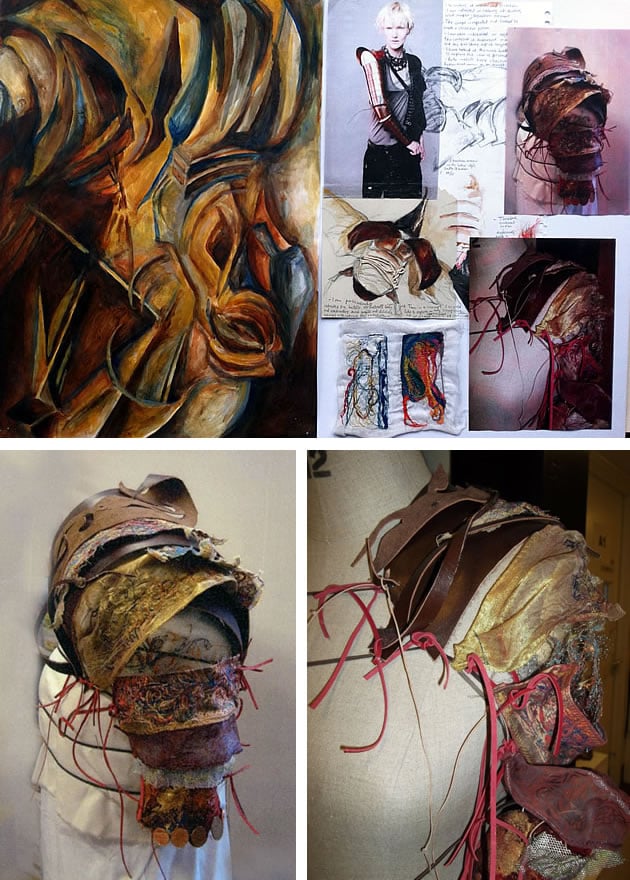
Every bit I researched armour I saw traditional metal suits and shields, simply besides discovered ancient Middle Eastern armoury and weapons. The irony is that weapons and objects that featured within ancient battlefields – places of such irreprehensible harm – were then beautiful and skilfully crafted. I was inspired by the beauty and forcefulness and wanted to explore these ideas of mixing difficult and soft. I began creating panels out of free machine-stitched patterns on muslin and then wired them to give shape effectually the arm. I likewise experimented using patterns in a more than subtle fashion, polyprinting onto brown leather. I created the print by softly drawing into a piece of polystyrene and and then printing the negative image. The leather was a compelling fabric to me, as not simply was it strong and felt authentic equally an indigenous armoury, simply it likewise suggested the idea of a pare. When I looked at the exoskeleton of the beetles and scorpions I was fascinated by having an armoury as a second skin.
For my A2 Textiles Coursework, I looked at cocoons and the thought of collecting and hoarding. My ideas and sampling led me to consider making an installation piece. I wanted to create containers to correspond the cocoon shells that were to go vessels for nerveless objects that were of import and therefore safeguarded and protected. With this in mind, the techniques that I used to make pods were very conscientious and time consuming. With a Japanese pattern cutting book Pattern Magic by Tomoko Nakamichi (Amazon affiliate link) my peers and I experimented with the shape called the 'Jabara'. I had never done whatever pattern cutting before, all the same I wanted to challenge myself and establish, with time, I picked it upwards. I found these forms to exist elegant and delicate when made in translucent and soft organdies and silks. These luxurious materials and the care the vessels took to create symbolised the attention a collector takes in preserving items of worth. With these pods I wanted to evoke a sense of accumulation, every bit occurs with the process of obsessive hoarding, where items with value are lost below the rubble of everyday rubbish. I decided to tie the delicate, finely constructed pods with more expressive and messy containers crafted from the collected materials themselves. With the collections becoming the materials, the cocoons are left hollow, just equally the collector is left feeling empty emotionally afterwards condign consumed past these meaningless scraps. To create these more exciting and tactile pieces, I began dying materials using batik to create negative resist images of fragmented fly patterns. I also stitched these butterfly patterns onto a vanishing plastic material, so that when completed the fabric dissolved with water, leaving the fragile skeletal stitched cartoon.
Which artists / designers did you study every bit function of your project? How take these influenced and shaped your work?
Halima: As part of the process of generating textiles, I continually collect visual information, especially inspiration from other artists or designers. I think it is also important non to limit the sources in which inspiration or ideas can come. Because I as well studied Fine Art, I drew ideas from sculptors, painters or installations, every bit well as textile and fashion work. One of the key examples of how seeing other designer's works in person can touch on or inspire work greatly was with my Growth and Decay project. I saw the Future Dazzler: 30 Years of Japanese Fashion exhibition, which featured piece of work from designers such as Issey Miyake, Koji Tatsuno and Junya Watanabe. Despite there not being any immediate connexion with my work, I absorbed as many influences equally I could.
Inside the exhibition, the pieces featured a make clean and simple elegance and aesthetic. There were very prominent sculptural qualities in the style the designers addressed the body and created shape and form. I was especially fascinated past the curled undulating textures inside a dress made from wired mesh and the honeycomb structures in skirts. These fluid forms resonated with me and I began looking at simple materials in new ways. I institute very modest paper cups and began cutting and twisting them around each other to answer to the shapes I had seen. Every bit I reflected on my work, this gave direction to my last piece, where I experimented with different ways to create the cup form and, through multiples, convey a sense of growing decay.


For my Armoury project I began looking at metal suits and observed how panels were built upwardly in layers and how the limerick of the suit featured strong shapes and lines. This led me to wait at Robert Delaunay and Marcel Duchamp's cubist paintings. They exuded vibrant blocks of colour and colliding fragmented shapes that became an nigh abstract pattern. I developed the idea of a deconstructed armoury forth with the patterns from the eastern shields I had seen. The designs of Hussein Chalayan were extremely inspiring to this piece of work. The manner in which he draped the fabrics, with their extremely embellished surfaces, felt very protective and he toyed with the concept of lighter layers being tied and joined to become a chunkier form around the body.
As I researched my project on Metamorphosis and Collecting I was fascinated by a Malaysian designer, who I discovered online, Ding Yong. Yong's Metamorphosis collection is visually arresting and alluring. Yong addresses the thought of cocooning, with a sinister edge. Tartan prints shroud and restrain the body, challenging the thought of form and part, equally the class beneath is immobilised. Through the designs, Yong creates a feeling of sheltering and suppression within a single body.

Every bit I began to consider the thought of installation for my Textiles projection, the work of Yayoi Kusama and Song Dong in his Waste Not installation were very alluring to me. Both limited ideas of repetition, obsession and backlog. I was fortunate to exist able to run across the work of both first-manus and the experience of viewing their work was pregnant. The pieces were entirely immersive; the calibration and the way the space was addressed created a suppressive and consuming temper for all. This resonating impact affected my work extensively as I took my textile samples and looked to construct an installation of my ain.
What advice do you have for other high school Art students who wish to proceeds splendid grades in a Textiles projection?
Halima: For me it was always more than about personal attainment and whether the work conveyed what I needed it to. I have found information technology is better to become then involved in the work and process that the grade comes as a secondary event. Exploring something in your piece of work that you lot are genuinely interested in – or that fascinates you – allows the work to come more than easily and organically. When you are pushing for ideas and it becomes a task, this shows through in what you make.
Within A Level Textiles I would say that it is crucial to bear witness lots of experimentation, processes and ideas, merely then be able to reverberate on the work and isolate the about successful elements to be pushed frontwards. Endeavor not to call up of the end results at the beginning of the project – permit yourself to be guided and these changes will make for a more than exciting last piece. By having a physical thought of what the work should be you tin can close yourself off from truly experimenting and learning.
Being able to demonstrate different techniques and skills is also of import. For case, it is okay to accept something appear messy or raw if this is justified for your purpose and you have shown you are capable of doing it in other, possibly more than refined ways. Information technology is ofttimes exciting to show contrasts and juxtaposition of different processes in a textile work.
The thought that each of us is entirely unique means that the work nosotros produce is wholly personal and irreplaceable, as information technology derives from our individual experiences. A quote that I found inspiring is from graphic designer David Carson:
You lot have to use who you are in your work. Nobody else can do that: nobody else can pull from your background, from your parents, your upbringing, your whole life experience.
Reflect on work with peers: often they will take the most interesting things to say. Even if they do not sympathize what y'all had intended for the work to be about, as creative individuals they tin suggest something to research further and develop within your work.
Be active. Piece of work cannot ever be made glued to a chair at a desk; the most exciting things happen when you accept a chance and try something.
The main slice of advice I would give would be to encompass all ways of creative expression and not be afraid to claiming or blur the boundaries. A Level Textiles is an extremely open subject field and if yous embrace the creative procedure, you may discover something unexpected of your work and yourself equally a maker.

Did you savour this article? Please share it using the social media buttons below!

Amiria has been an Art & Design teacher and a Curriculum Co-ordinator for 7 years, responsible for the course design and assessment of student piece of work in 2 loftier-achieving Auckland schools. She has a Bachelor of Architectural Studies, Available of Architecture (First Grade Honours) and a Graduate Diploma of Instruction. Amiria is a CIE Accredited Art & Pattern Coursework Assessor.
Source: https://www.studentartguide.com/featured/a-level-textiles-sketchbook
0 Response to "A Level Textiles: Beautiful Sketchbook Pages"
Post a Comment